Tuesday, May 31, 2016

Another uneventful day.

I just realized that I didn't post a single picture of our chickens (and half-our goats) this month, so here's a quick update.


CHICKENS 


Chickens are happy as usual. As the fowl proverb goes, No events are the best events, so today's uneventful morning was the best morning ever, just like yesterday's ...

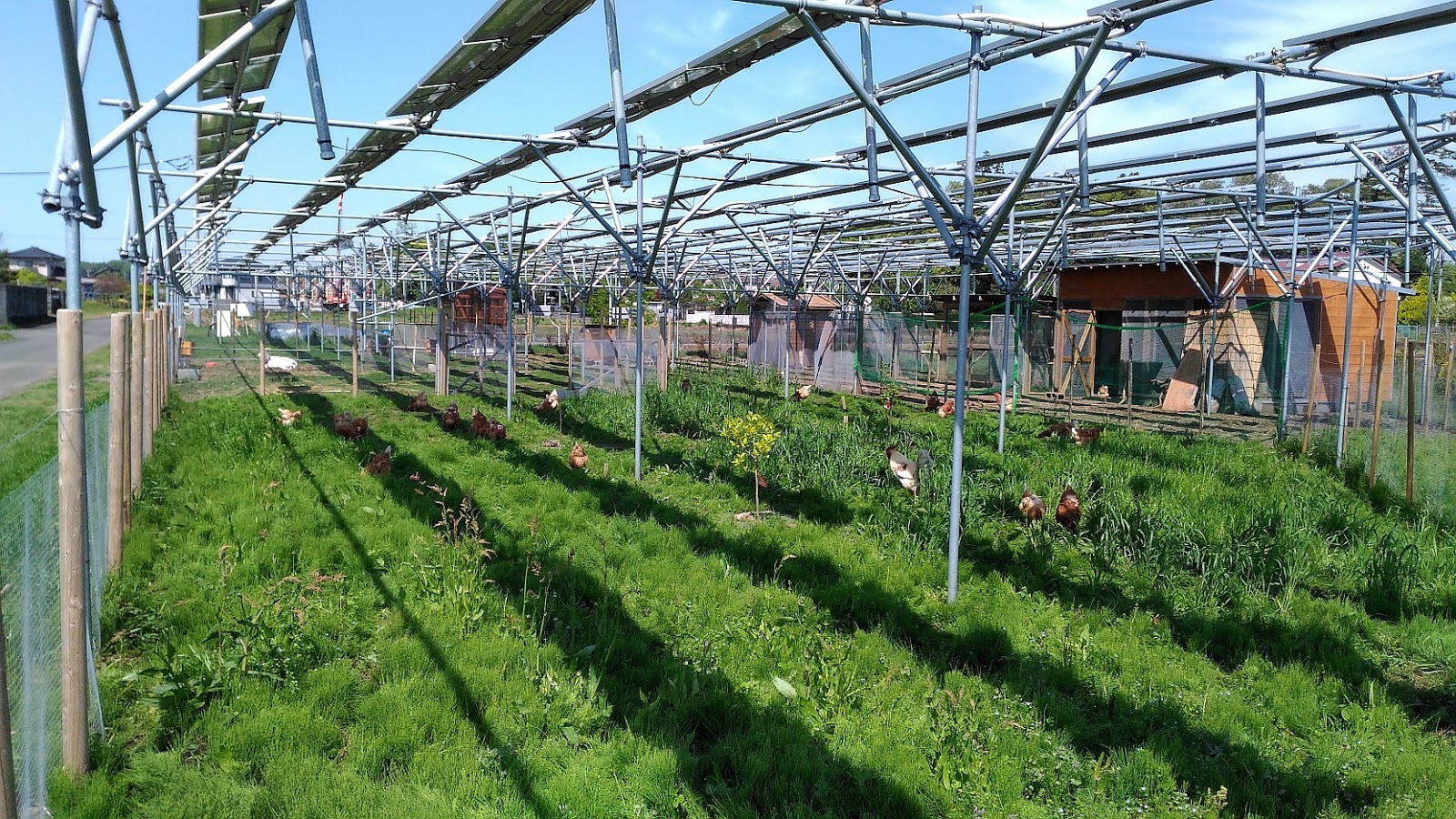
Free range chickens out in the run. Solar sharing farm.
"I'm so thrilled! This morning is so uneventful!"
(May 31, 2016)

Free range chickens in Japan, Tsukuba. Solar sharing.
Morning thrill from another angle.
(May 31, 2016)

I think we need a reminder that these chickens actually work, and full time! Here is a papparazzi snapshot from a few weeks ago.

Free range eggs, Tsukuba, Japan. Solar sharing
"Just ended my shift, see ya tomorrow!"

And here's today's harvest!

Freshly laid free range eggs. Solar sharing farm in Tsukuba, Japan.
Hello, we're future sunnysideups and omelettes. (May 31, 2016)

That's it about work.

Our chickens rarely have direct interaction with goats, but when they do, it's very exciting. For the goats, especially.

Baby goats attacking a chicken coop.


Goats and chickens under solar panels.


A baby goat and a chicken inside a chicken coop.


Three baby goats having fun destroying a chicken coop.
And so the baby goats messed up everything and then went home
for a good night sleep.


GOATS


Goats are, well, happy as usual!

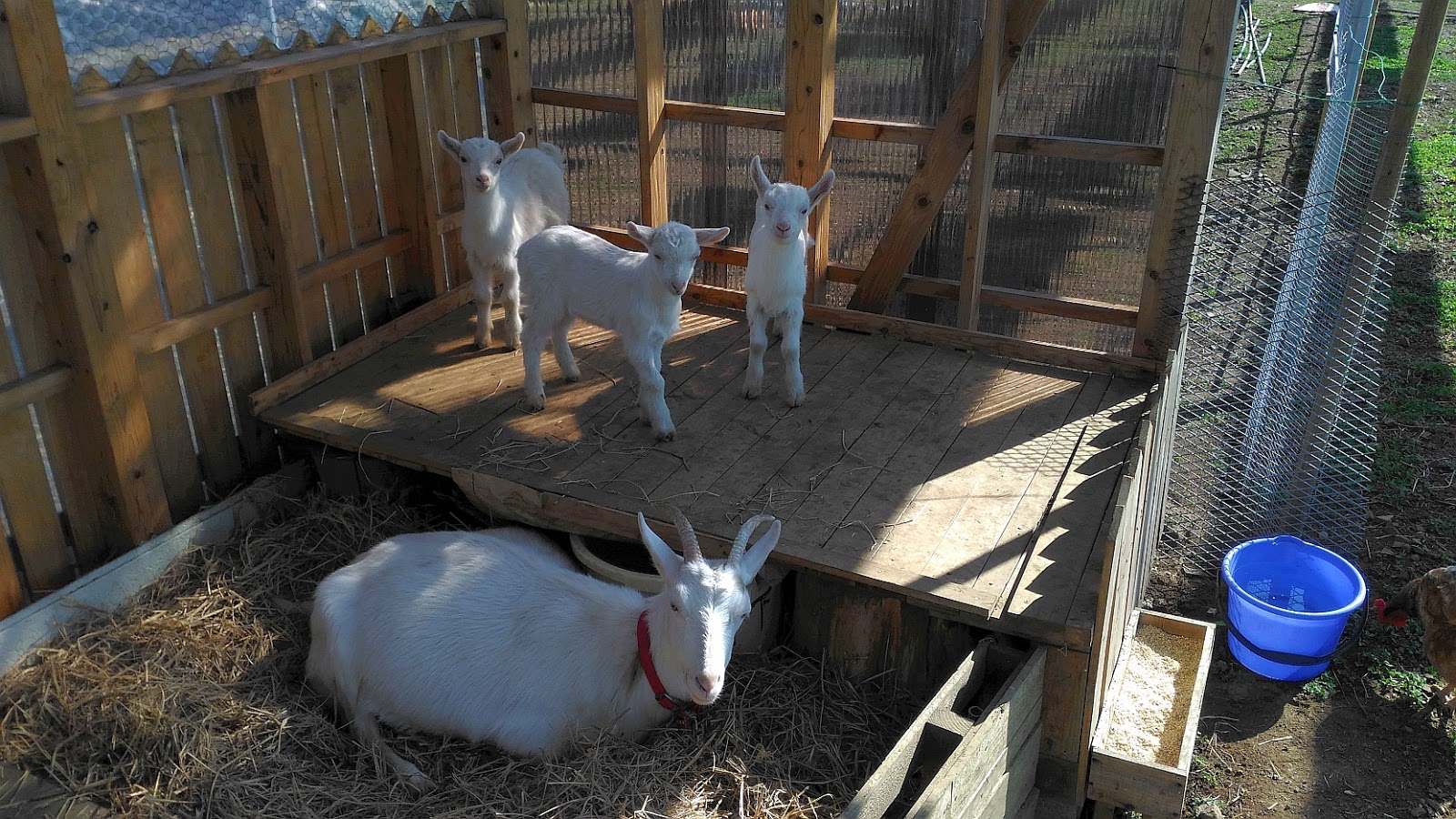
Natchan on a sunny morning two days ago.

More Natchan on a sunny morning. 

"Hello!"

And here are the triplets.


The triplets are now over two months old and have switched to grass diet, although they still crave for mum's milk, which the mum is rarely willing to give them.
Last time, of the three siblings only the girl had a name, Momo-chan. Now the two boys have names too! Aito-kun (the one with horns) and Akio-kun (without horns).


And finally, a fail-proof way how to become a goat's best friend.


(Hint: Repeat action in the video at least once a day. 
ALWAYS have the right leaves or grass.
After two weeks, goats will be emotionally bonded to you.)


***** The end of quick update *****

Monday, May 23, 2016

A priceless goat milk deal

Just two kilometers from our farm, there is a very special place. It's grassy, it has rice fields on one side and a river on the other, and goats are grazing there almost every day of the year.  One of them took a picture with me!


Me taking a picture with a lovely goat in Tsukuba, Japan
A Goat and a me.

These are not just any goats. These goats' milk and yogurt I've been occasionally having for breakfast for the past few months.
After several virtually milk-less and yogurt-less years in Japan, this is a welcome change. I'm deeply indebted for this treat to the goats and to their owner Fujioka-san.


Fujioka-san and one of his goats, near Sakuragawa river, Tsukuba, Japan.
A Goat and Fujioka-san.


The special thing about these goats' milk is that it's priceless - literally. You can't buy it anywhere, no matter how much you'd offer. This milk is not for sale.

Raw goat milk not for sale. It can only be bartered. Tsukuba, Japan
Ha!


There are two reasons why Fujioka-san will not sell this milk, or yogurt, or cheese, to you: one is a prosaic technical reason, the other is a philosophical one.

First, the prosaic reason. In Japan it's forbidden to sell unpasteurized milk or products made from such milk, like unpasteurized yogurt or cheese. (Unless it's imported  cheese, in which case it's okay. Smells like double-standard? Yep, that's what it is.) Of course, if you have goats, you can have raw milk for personal consumption, but you're not allowed to sell it.
In the process of pasteurization, milk is heated in order to kill microorganisms present in raw milk. The official reason is food safety, the real reason is extending the shelf life, which enables mass production, mass distribution and mass consumption of milk.

Unfortunately,  pasteurization kills not only the 'bad' microorganisms, but also a lot of the 'good' ones (the "probiotics"), as well as some very good enzymes, vitamins and minerals.
So pasteurized milk has less bacteria,  but also less nutrition and poorer taste.


The difference between raw and pasteurized goat milk is huge.


The milk from Fujioka-san's goats is raw, which means it's valuable, and unsellable.  The only way how to get it is: Step 1, become friends with Fujioka-san; Step 2, if possible, have something useful to barter. With this predicament, I feel lucky to have our hens, because I can barter their eggs for goats' milk and yogurt.  It's been working for a few months now and I couldn't imagine a better deal.

Two happy persons bartering priceless goat yogurt for priceless free range eggs.


The topic of bartering leads us to the second, philosophical reason why this milk is not for sale: It's because Fujioka-san prefers non-monetary exchange. If you're wondering why would anyone prefer bartering to hard cash, you'd better ask Fujioka-san directly. My attempt to explain his theories, relying only on my poor memory, would lead to inexcusable distortion.

Reasons why this goat milk is not for sale: 1. it's not allowed, 2. money is boring.


Speaking for myself, bartering feels good - much better than buying stuff in a big, impersonal store. The best thing about bartering is, obviously, the fact that it doesn't involve money. When money - with the exact price and the notion of "cheap" and "expensive" - is not involved, other dimensions can come to the foreground, most importantly the object and the subject of the barter deal. The thing and the person. Everything that is usually invisible, hidden behind the price tag, is now part of the deal. Your bartering partner is not a stranger but a friend. The two things that change hands are made with attention and pride, and are appreciated by the other side. Also, the amount (what would otherwise translate into an exact "price") is fluid. This time I have fewer eggs than last time,  but Fujioka-san has more milk, and that's fine. Next time it might be the other way round, or maybe not. Nobody is calculating. Bartering is flexible, because it's not about money.

An image explaining the difference between Bartering and Buying.


But what I most appreciate about this milk is not that it's raw, or that it's bartered, although these two features certainly make it very special. My appreciation has more to do with the goats.

The reason why I haven't been consuming much milk or yogurt in Japan is not their unavailability. There is plenty of milk and yogurt in grocery stores and they are cheap, but knowing the reality behind Japan's dairy industry, I simply didn't feel like buying any.
Fujioka-san's goats are outside eating grass on most days, and the baby goats spend at least the first month of their life with their mum. As far as I know, neither of this can be said about generally available mass produced milk and dairy products, where cows are kept inside the barns, eat grain rather than grass, and calves are separated from their mums soon after birth.

To me, bartering milk provided by goats grazing just two kilometers off my place is much more fun than buying anonymous milk in the supermarket. One thing I should work on now is to go and say hello to the goats more often. Now that I have quite extensive knowledge about goats' favorite types of grass, I'm pretty sure I could bribe them into a friendship :)


Saturday, April 30, 2016

Chickens' new old run!

Do you remember how I complained about Christine the Destroyer Chicken sabotaging our efforts to revive grass in chickens' old run? Of course Christine wasn't destructive enough to beat the power of spring. The grass and weeds have grown big and since yesterday, chickens are finally allowed to use their old run again.

These are the very first moments after Grand Opening yesterday afternoon.

"Bugs! Where are the bugs?! And worms!" (There should be plenty.)

"How do I look against the green background?" (Cool.)


And some fresher pictures from today morning.

Grass carpet inside and outside the fence is now equally green.
Zoom in to find the chickens.

The highest occurrence of chickens is in the shade strips.

Someone is either taking a picture with their phone or drinking something from a hip flask.

Meanwhile, baby goats are growing big too and even started to eat grass and people's fingers!

Momo-chan (red collar) and her brother.


Like all mums, Natchan the Goat Mum is quite resilient.

There's no concept of "busy" in goats' world.


The end.

Wednesday, April 13, 2016

Goats are back!

Yesterday morning I came to the farm to find 31 chickens and four goats. Natchan is back!


Natchan and her triplets.
More of Natchan and her triplets.  
Natchan having breakfast, mildly obstructed by offspring.

Triplets soon discovered the beauty of high places.

We've just started climbing!
We're training hard...
This is a picture of some cool mountain goats.
... so that one day we can be like this!


After 5-minute long climbing session, the family withdrew into their summer house.

How many chickens and goats are on the picture?

Correct answer: Four chickens ...

... and four goats!

Jumping on mom's back is so much fun.

... Almost as fun as having a nap.


And finally, Natchan the Goat breastfeeding in public. Outrageous.


To be continued...


Thursday, April 7, 2016

How rain affects chickens' ability to fly and think.

Today was raining. Here are today's rain-soaked chickens eating lunch:


(Don't get fooled by chickens pitiful looks. As long as chickens have access to outdoor run, they will always look pathetically fluffless on rainy days, because they choose to go outside despite the rain. As a firm believer in chickens' free will, I don't try to stop them.)

But there is one new, super interesting observation from today:

Rain affects either chickens' ability to fly or their ability to think. 

I couldn't yet figure out which one.

This observation was made thanks to Christine, the Explorer Destroyer Chicken who often flies over the fence to a "Chickens Forbidden" area. There she conducts various illegal activities.

When it's lunch time, all chickens sprint to the coop to get to food as fast as possible and grab the best pieces before everyone else. But Christine is usually playing alone in the forbidden area, separated from the rest of us by a fence, so if she wants to eat, it's not enough for her to sprint, she also has to fly over the fence.
For most chickens, this is a problem. Chickens have trouble understanding the concept of a detour - taking a longer route to get to one's destination, rather than the shortest one. If the destination is right in front of chicken's eyes, in chicken logic it must be reachable by the shortest available route - straight line. Anything else would involve temporarily distancing oneself from the destination, and is therefore (in chicken logic) incorrect.
Obviously, if there is a fence separating a chicken and her destination, only the longer route (flying over the fence) is the option, but this is extremely difficult for chickens to grasp.

This has never been a problem for Christine, though. Except for a few early instances, she has always been able to find her way from the forbidden area to food by the longer route - until today. Today, she couldn't make it! She didn't know how to get to us from behind the fence. She was frantically running back and forth along the fence, as you can see in the latter part of this video:


As the only difference compared to all other days is the presence of rain, Christine's sudden inability can only be explained by the rain. Rain impaired either her ability of logical reasoning, or her ability to fly.

For those worried about Christine's well being: Don't worry, she wasn't left hungry. She was immediately helped back to the run, where she joined her fellow gobblers, as shown in the following video, taken about five minutes after the previous one. (Christine is in the center, the one with yellow ring on her left leg, suspiciously watching the camera. )


Both hypotheses (does the rain affect flying, or thinking?) will be tested on the next rainy occasion. Chickenology is a serious science.

Friday, April 1, 2016

Price talk: Are our hens' eggs expensive?

We have 29 hens and 2 roosters on our farm and we sell their eggs. Our chickens roam freely in a big outdoor run all day. They are “farm animals” but they are treated more like pets. Some of them have names. When a hen got injured, we took her to the vet (she recovered).

We sell their eggs for 60 Japanese yen (0.5 USD)/egg.

That is 360 yen (3 USD) for a box of 6 eggs, or 600 yen (5 USD) for a box of 10 eggs.

The other day I went to the supermarket and I happened to walk by the egg section. As we only eat eggs from our farm at home, it has been a long time since I had a closer look at supermarket eggs and their prices. I knew that our eggs were more expensive than "normal" eggs, but what I saw was still surprising.

Our local supermarket egg section: Prices are without 8% consumer tax.
(click on picture for enlargement).
↓
Prices with tax (= final price for consumers).

The eggs were sold, on average, at about 20 yen/egg – that is one third of the price of our eggs. The cheapest package cost only 163 yen - just 16 yen for an egg. This is considered a normal price of eggs in Japan.
For comparison, one apple in Japan costs somewhere between 100 - 200 yen, one potato about 40 yen, a 500 ml bottle of Coke 150 yen. One beer in a pub will cost you about 500 yen. An average monthly salary (net income) is about 250,000 yen.

Needless to say, all of the eggs on the above picture come from the most "efficient" and in Japan still the most prevalent production system - cages.

Our hens' eggs cost three times more. I don't think they are expensive, but I understand that some people may find them overpriced.

So here I would like to explain what constitutes the price of an egg from our farm.


What does the price of our hens' eggs include? 

The following graph shows what the price of 60 yen/egg from our farm includes.

Click on image for enlargement.


This calculation is based on actual or precisely estimated costs,  assuming that we will keep selling eggs from the current flock for the period of one year and manage to sell on average 80 % of eggs. (The rest we eat ourselves, barter for other goods, or spend in other useful ways. If we manage to sell more than 80%, that's great. So far we haven't.)

The same calculation in percentage points:

Click on image for enlargement.


Here is each category in detail:

Operating costs in pre-production period ( 6 yen out of 60, or  10% of price)
Pre-production period is the period between 0-5th month of chickens' life, when they don't lay eggs yet, but need care and feed.
Operating costs in pre-production period include: (1) price of baby chicks, (2) their feed for 5 months, (3) electricity (used for baby chicks heat lamp, lighting, pumping well water etc).
It does not include other expenses such property tax and gasoline (e.g. car trips to buy feed).

Operating costs in production period (17 yen out of 60, or 28% of price)
Production period is the period between 6-18th month of chickens' life, after they start laying eggs.
Operating costs in production period include: (1) feed, (2) packaging, (3) regular salmonella testing, (4) electricity.
It does not include other expenses such as property tax and gasoline.

Initial investment (13 yen out of 60, or 22% of price)
This includes the cost of building chicken coop (the new coop) and a fence, calculated for a return period of 7 years (that is, about 15 % of initial investment should be paid back from egg sales every year).
It does not include the cost of building the old coop and of digging a well. (Which were both built for the chickens and both are essential for continuing the farm.)

Labor costs (24 yen out of 60, or 40% of price)
This is the cost of our time.
If 80 % of eggs get sold every month at 60 yen/egg for the period of one year, my "salary," calculated for the period of 18 months (to include the chickens' first 5 months of life, when they need a lot of care but bring no income) would be 9,733 yen/month.

So, to sum it up, selling eggs from our farm yields a salary of less than 10,000 yen/month. If we split it with Nobuo, we get almost 5,000 yen each!

This was the basic analysis of the price of our hens' eggs. Thanks for reading! If you are not bored to death yet, more detailed explanation follows.

***********

Self-employed people usually don't count their income in terms of hourly wage, because most of us would get very depressing numbers. But it can be quite illuminating, or maybe a good joke, to do so here.

Work on the farm typically takes about two hours a day, divided into several short sessions following a day cycle. This mostly includes feeding the chickens and collecting and selling eggs. These two hours do not include any extra work that is done with less-than-daily-frequency (shopping trips to buy feed; delivering eggs, picking up okara, taking eggs to the health center for salmonella check; catching escaped chickens; writing this blog...).

So the work normally takes two hours, but for this calculation let's assume that all the work on the farm could be done super efficiently in just one hour a day, 7 days a week, 365 days a year (chickens need to eat on national holidays too). Then the monthly reward of 9733 yen would mean a wage of about 324 yen/hour.
For comparison, the minimum wage in prefecture Ibaraki, where we live, is 747 yen/hour.

Of course, this is a silly calculation. Our farm is not just a business, it's also a hobby and an experiment. The experience and the fun is just as important as the monetary reward. But the truth is that in strictly economic terms, our chicken farm is not a self-sustaining business, even if the eggs sell great.

The reason why I go to such lengths to explain all this is to show that the price 60 yen/egg is not unreasonably high. It reflects real costs, which we are trying to keep low, and very modest profit.

The point is that the price of 60 yen for an egg would not be too high even if we had 100 chickens, not 31 (provided that the 100 chickens were kept in the same happy "free range" conditions). Then it would finally become a feasible business model: The farmer would make enough money to consider it a meaningful source of income - still just a side income, but one worth putting the time in. It would finally be a sustainable solution, when doing the right thing also helps pay the bills.
(By the way we don't plan to increase our flock to 100 chickens. Given the limited size of the farm, chickens would not be happy with such a population increase. They would eat up all the grass. They couldn't all fit into the coop. And there wouldn't be enough customers for so many *expensive* eggs. This was just a theoretical extrapolation.)


Higher prices of eggs produced on smaller, more animal- and environment-friendly farms are a result of higher costs, not just greenwashing. (Although they can be. If possible visit the farmer whose eggs you buy, and make sure the farm is what the label says. Good farmer should be happy to show you around.)

Frankly, I can't imagine how a small farm dedicated to ethical and ecological practices could sell their eggs for anything less than 60 yen without compromising either animal welfare standards (overcrowded barns; no outdoor run) or farmers' wages (working too long for too little compensation) or environmental standards (sloppy waste disposal) or  food safety standards (no salmonella tests).

Conclusion 

Based on the math above, I dare to conclude that 60 yen is a just price for a humanely and locally produced egg.

Obviously this is an unconvincing conclusion from someone who actually sells eggs for that much.

The only thing I can say to my defense is that our chickens will not be here forever and the time will come when I will move back to the consumer side of this story. When that time comes, I will  be happy to find a farm like ours that treats chickens well, tries to feed them locally and is generally a nice place, and asks only 60 yen for one egg. I will not consider them expensive.

As someone with low income myself, I will solve the question "How can I afford to pay 600 yen for 10 eggs?" very easily - every month  I will simply give up a few soft drinks from a vending machine, or have one less beer when occasionally meeting friends in a pub. Just one less beer will save me almost enough money to buy those ten eggs.
I only hope I will find a farm that will produce them.

I hope so too!

Monday, March 28, 2016

It's a girl! And two boys!

On March 23, Natchan the Goat gave birth to a girl and two boys!

Here's the new family four days later:

three baby goats and their mom
Natchan the Mom with her children. (2016/3/27)

4 days old baby goats are pretty much like toddlers rather than "babies." 

The one with red ribbon is the girl !

Mom goes out, we go out!

Pretending to be eating grass, like Mom does!
Natchan and her new family will stay in their home for a few more weeks. They plan to come back to our farm in mid-April. (Navigating three small, ultra playful baby goats to the farm along a road where cars may pass is not an easy task. It requires some logistics, and the goats must also grow a bit bigger and be able to walk faster and in a straight line. Right now they just totter in funny drunken ways and jump around without much control of where they fall or what they bump into.)

Mom mom mom more milk mom mom!

Okay, here you go.
These days the siblings mostly sleep, and when they don't sleep, they eat (Account by Mrs. Yagishita). Aah, I'm so envious of their busy schedule.